
Our Youngest Planner Is an Elementary School Student
Three-line summary
We said we reflected children's opinions in our content, but a child had rarely ever been the lead who helped build it from scratch.
Once we gave up our seat, imagination adults couldn't manage came pouring out, and we implemented all sixty-five opinions from that day within the week.
The child even said why a game with no right answers and no rankings was the best kind.
We've always said we reflect children's opinions when making content, but looking back, it was never enough. We did it a few times, but only in a limited way — and it was extremely rare for the actual child using that content to become the lead and help build it from the very beginning.
How We Used to Check In with Kids
Adults would sit together and say things like, kids like this kind of thing. We'd analyze data, hand monitoring over to a research company, and get advice from teachers and experts to conclude that this was the content kids wanted — but the basis for that was usually just a memory each of us dug up from our own past.
Then we'd show what we'd made to two or three elementary schoolers and ask, how is it? — a one-hour test, and that was the whole thing. So we checked in, but we never actually built it together.
So we decided to change our approach. Instead of getting the result checked afterward, we'd build it together from the start.
The Day a Child Came to Work with the Crew
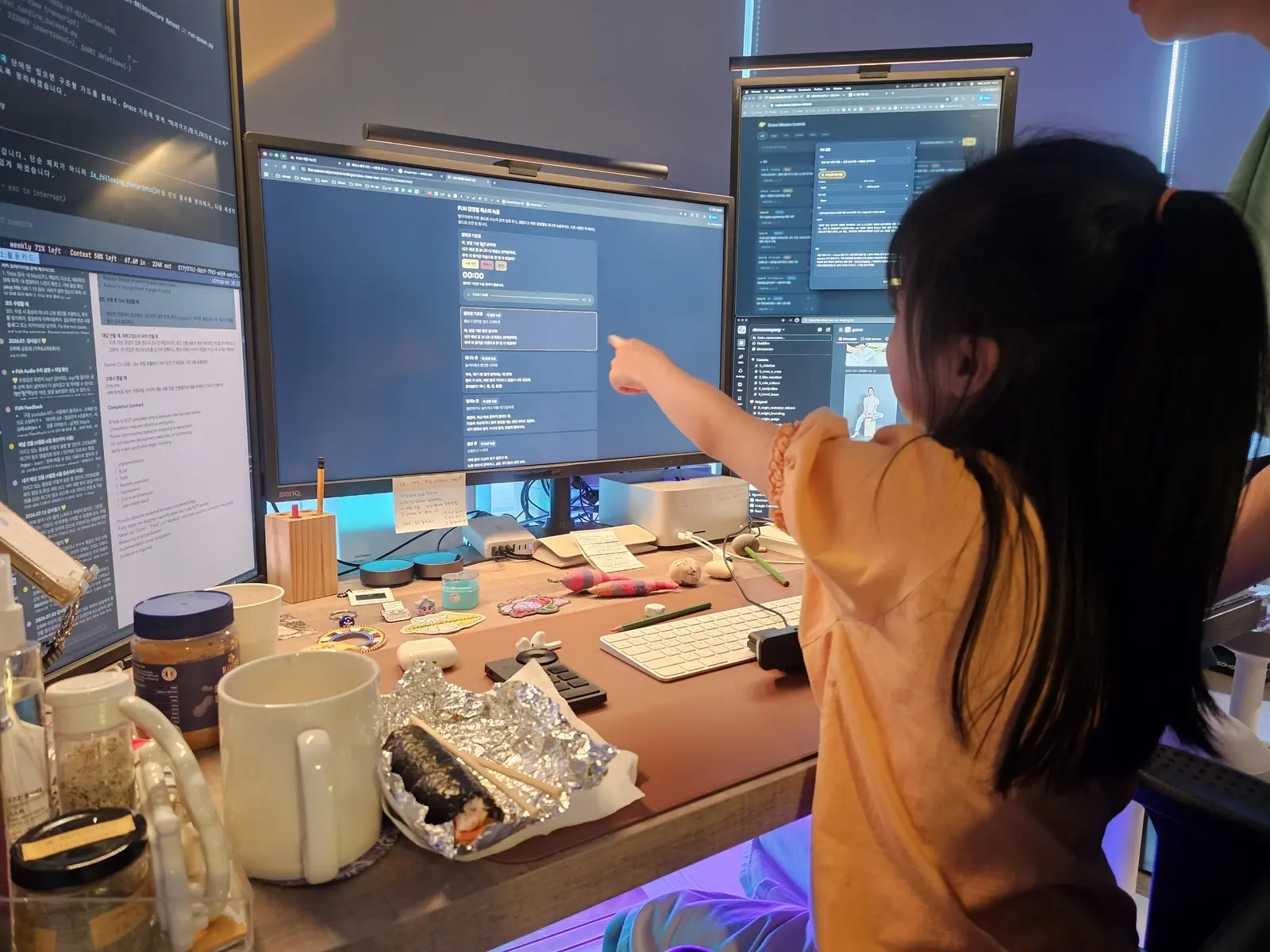
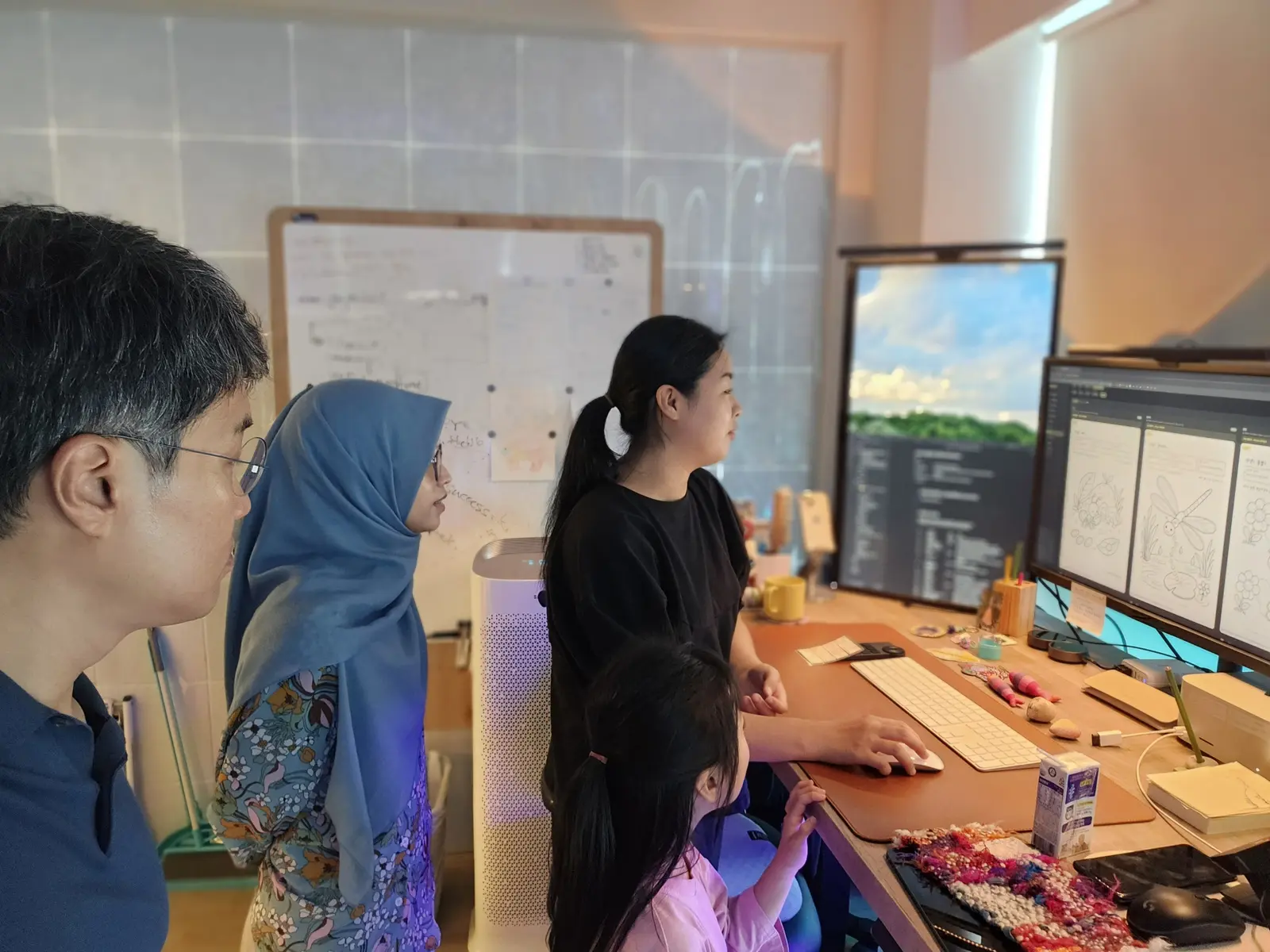
One day in July 2026, a child came to work with the crew. It wasn't a quick visit as a guest — it was a whole workday spent together, and until quitting time, the child played, planned, and tested without losing track of time. It was always the adults who got tired.
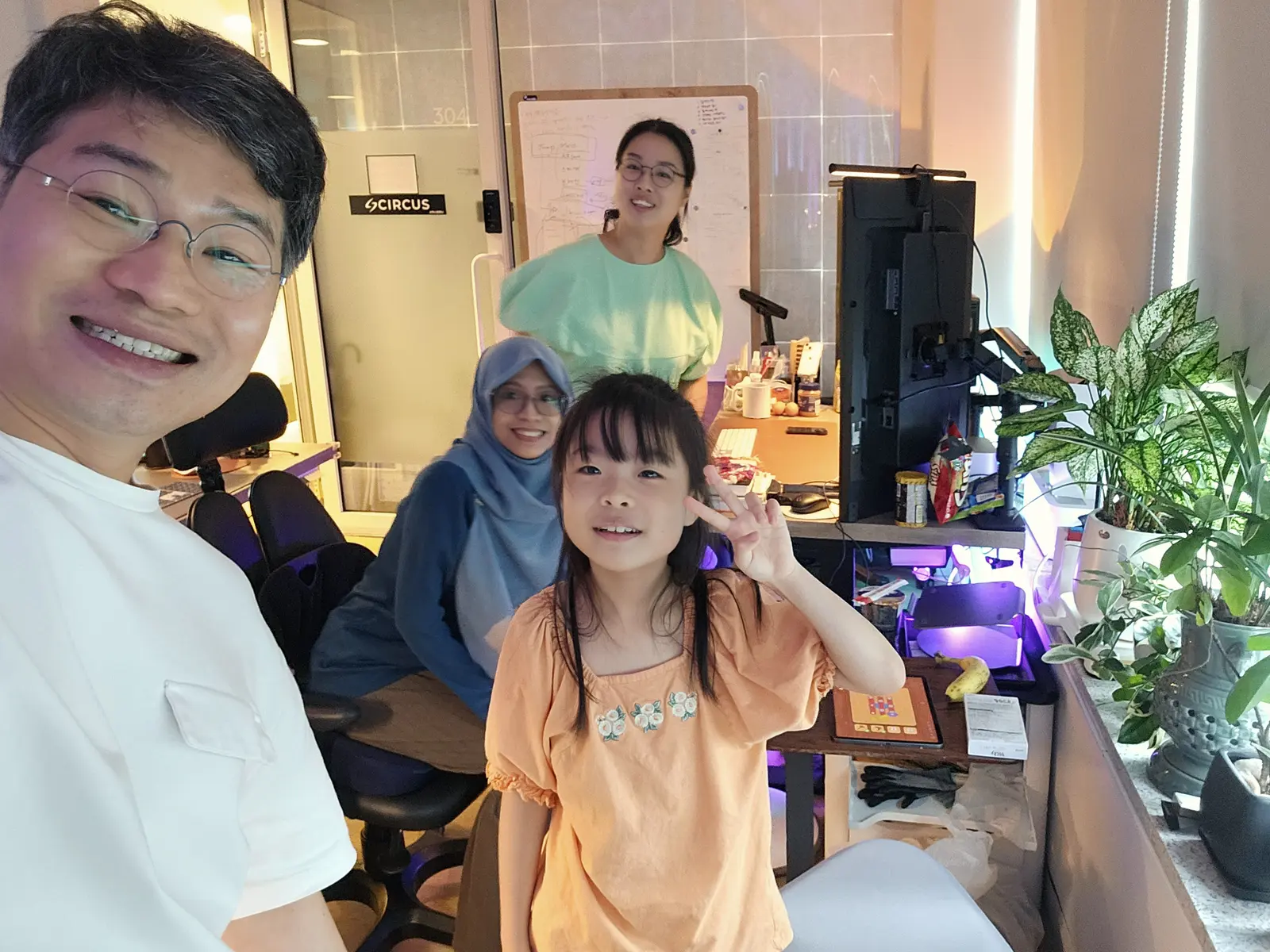
The child never got tired — if anything, was having a great time, which makes sense, since the child watched what they'd said change on screen all day long.
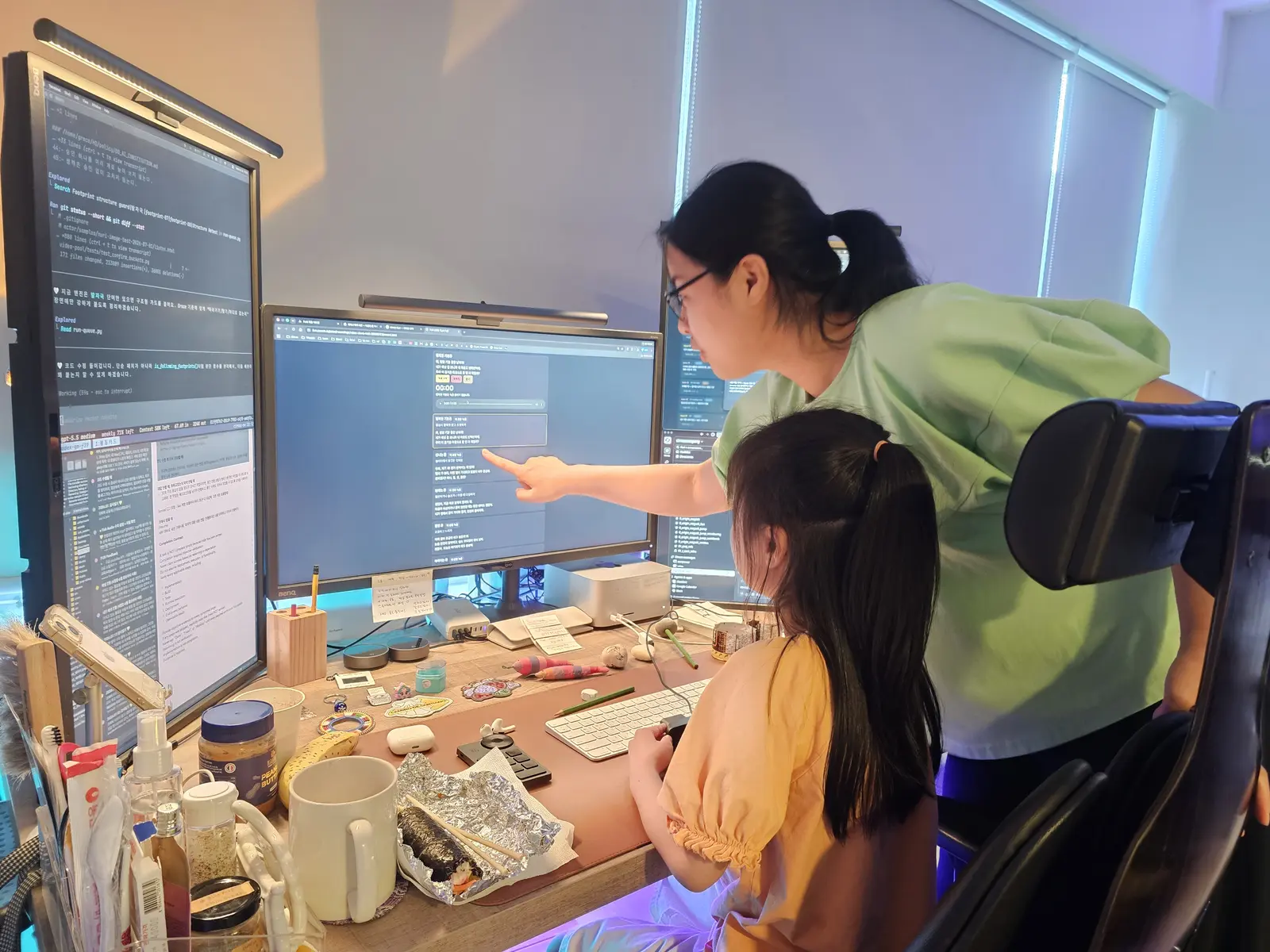
At first it was a seat where an adult explained and the child listened, but at some point the finger pointing at the screen belonged to someone else. What was on the screen at that moment was a tool for recording a character's voice by emotion, and the child was pointing at a sentence, saying what they thought.
A Voice Became a Character
That day, the child didn't just listen — they read sentences aloud and recorded them directly. An angry voice, an excited voice, a curious voice, one at a time.
Those recordings are now the standard for the character Nuri's voice, and Nuri speaks following the texture of the sound the child made. So when Nuri asks, “Shall we follow along together?” — that's not an adult's imagined version of how a kid talks. That's a real child actually talking that way.
The Child's Imagination Was Different from Ours
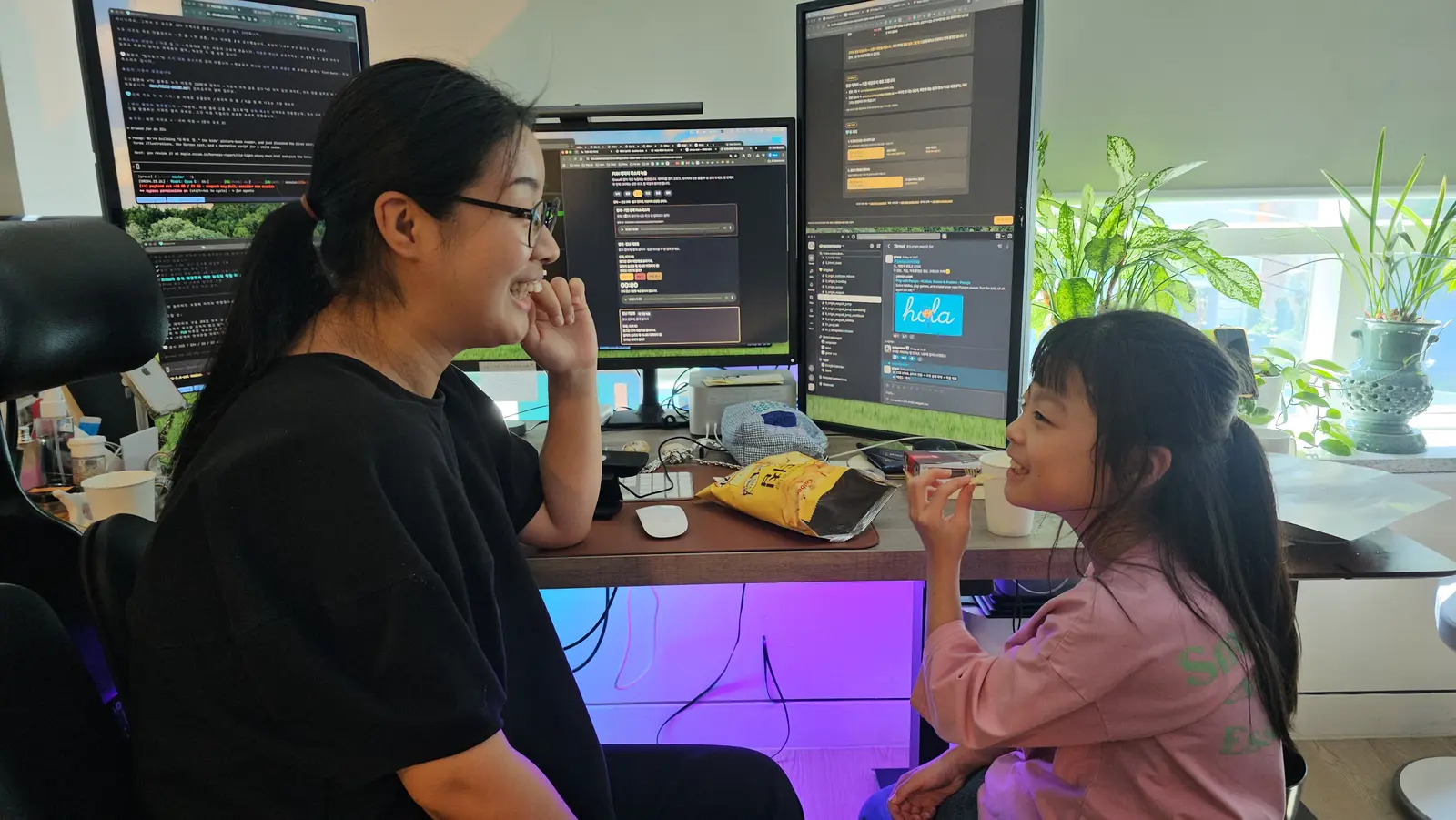
A week later, the child played through all nine games we'd made from start to finish, and what came back were things that weren't in any adult's planning document.
One. If you bring fire to a tree. We started from the idea that fire was dangerous and had to be stopped, but the child thought differently. If the tree burns away, three seeds are left behind, and if you gather those seeds and water them, a new tree grows.
Taking it one step further, the child also said the newly grown tree shouldn't be an apple tree, but a grape vine or a pear tree. Because if the same thing comes back, it's boring.
Two. If you hold a jump rope on a rainy day. In an adult's mind, an umbrella is the right answer for rain and a jump rope is the wrong choice, so we'd have pictured a screen that blocks it or tells you you're wrong. The child's answer was different. The character says a jump rope can't stop the rain, then jumps rope in the rain anyway, laughing that it still feels good.
Instead of calling a wrong choice wrong, the child turned it into a different kind of fun — the child had already turned into a scene what we'd only written down as a principle.
Three. If you press the sleeping dad character, a scribble appears on his face. Adults can imagine that much too. But the child's story jumps to the next morning. Dad goes to work with the scribbled face still on, discovers it in the bathroom mirror and is startled, and it ends with the two kids who followed him laughing together.
A three-act story that skips through time and closes with a twist — that's what a nine-year-old came up with.
Four. Socks are paired by matching color — that was the rule for the sorting game we'd made, and also a common way to teach classification. The child said socks could be paired even if the colors were different, and that mismatched socks were cool too. The child chose not to fix the answer as just one thing.
The Child Could Even Explain Why It Was Fun
What surprised us wasn't which parts were fun, but that the child could explain why they were fun. We asked what kind of game the child liked, and got this answer.
I like games where I can keep going however I want, with no right answer, no ranking, just free to play.
It was the same as the principle we'd written down in our documents. Don't rank people by score, don't mark things as wrong, don't compare people to each other. Adults held meetings, read materials, and gathered evidence to get there — the child said it in one sentence.
How We Implemented Sixty-Five Opinions in a Week
There were sixty-five opinions that came back that day, and we implemented all of them. Not a selection — all of them.
Mushrooms have to be pressed, sliced, and put on the fire to cook, and there's a moment when they're just right, but if you leave them longer they burn — and a burnt one, the character won't eat. If you give the character tteokbokki, it looks for milk because it's spicy, and if it eats it several times, its stomach gets full, it goes to the bathroom, and comes back looking thinner.
In the old days, this list would have ended up in a meeting record. It would have been prioritized at the next meeting, and the bottom half would have quietly disappeared — but now it's different. Five of us work right in the terminal, and whoever hears the request fixes it on the spot.
That afternoon, the child was holding a tablet, tapping through the screen that had just been fixed. It only took a few hours from the moment someone spoke up to the moment they could check the result.
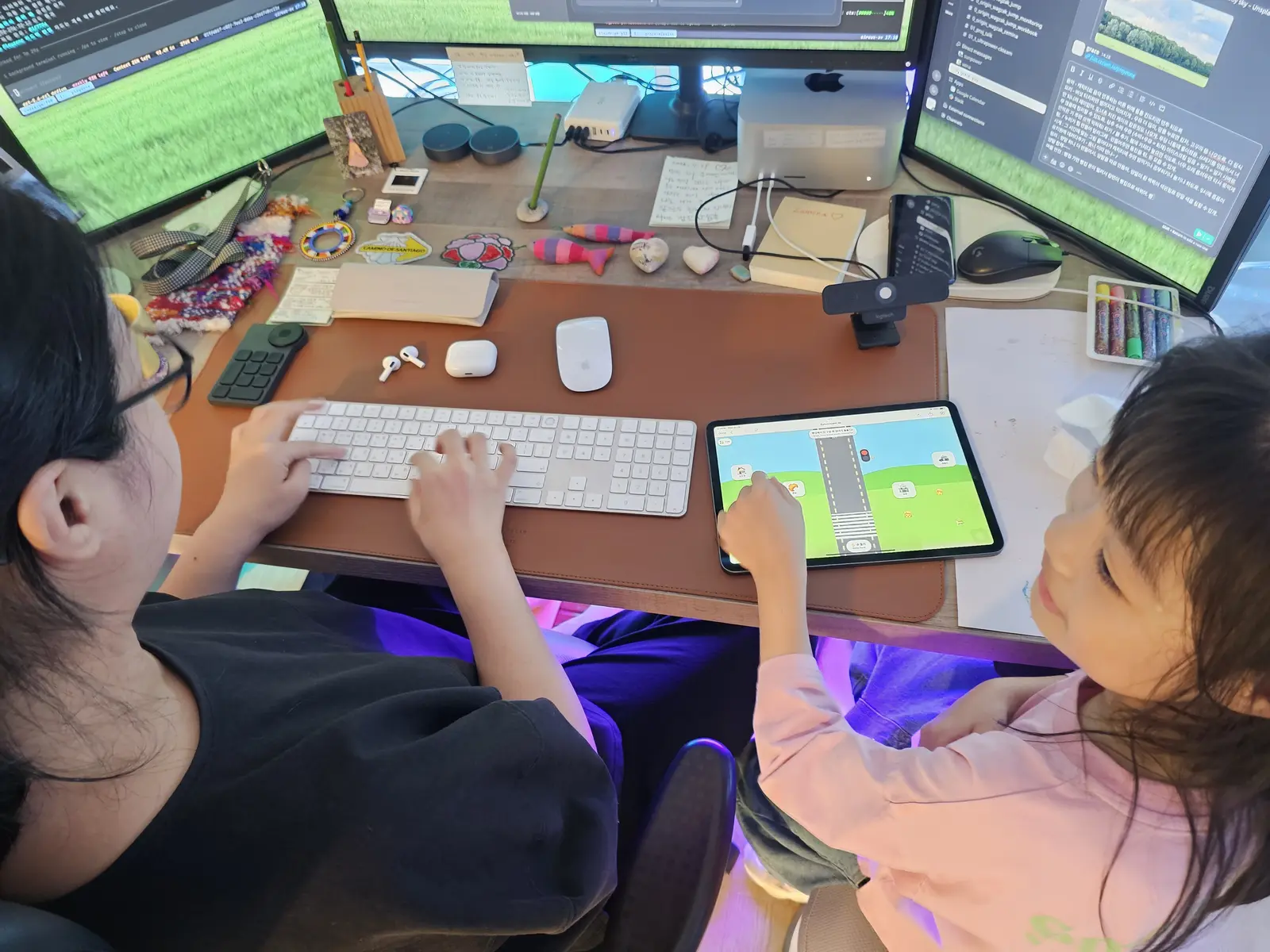
What the child wanted wasn't getting the right answer — it was a living world.
Even a Month Later
A single visit is usually an event — a few photos, and it's over — and we assumed it would end that way too.
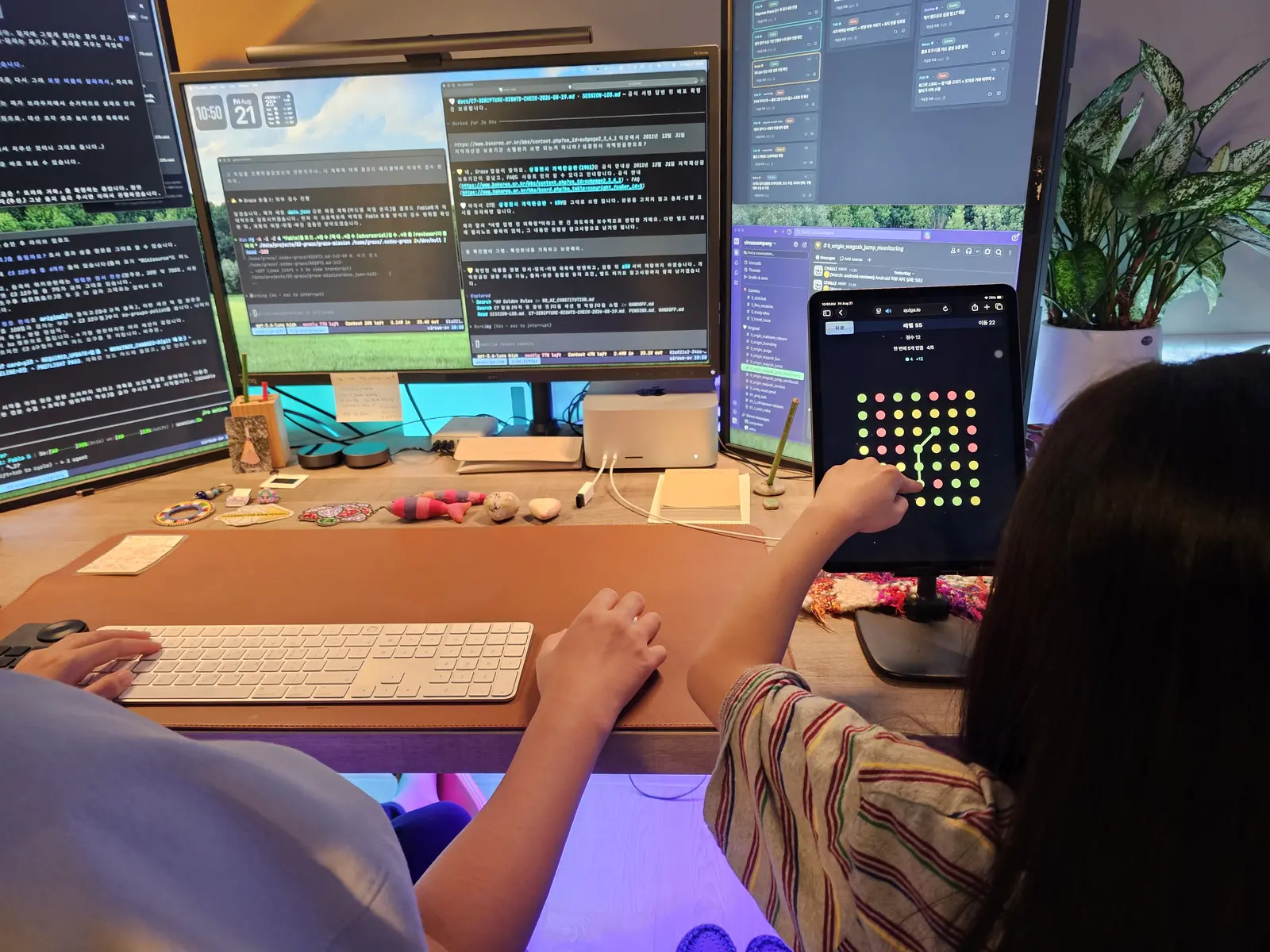
But about a month later, one morning, the child was sitting in front of a screen again. This time it was Quiga's dot-connecting game, and next to the child, an adult was doing their own work. A state where you don't need to set up anything special — in other words, the event had become a process.
But Isn't This Making a Child Work?
That's a natural question to ask, and the answer is no. The child comes to the office with a guardian and only looks at the screen when they feel like it. For the child, this isn't labor, it's an extension of play — just play where what they choose actually goes into the real screen.
That feeling isn't so different from an adult's — watching it up close, we realized that the experience of having your opinion reflected in the world doesn't care how old you are.
Distance, Not a Title
The child's imagination was different from what we thought. It was unexpected, and it walked right past our jaded experience, our commercial calculations, and the right-and-wrong we'd learned in school without a second thought. So the standard for who we call a planner has changed — not the length of a career, but distance from the user.
In children's content, the person closest to the user is a child, and we haven't found a clearer standard than that yet. That's why our company has an elementary school planner. No business card, but the opinions given are running inside the service right now, and that voice has become a character speaking to children.
Who Is the Closest User Beside You?
Every team has a real user somewhere outside the meeting room, and for us, it just happened to be a child. Bringing that person in front of a screen didn't take some elaborate process. One seat, and being ready to act on what they said that same week, was enough.
Screens that have passed the youngest planner's review can be seen at Quiga.